A copper earthing rod earns its higher purchase price only when the site conditions, fault duty and maintenance plan justify it. By comparing copper with copper-bonded steel and GI, then checking the soil, installation design and test records, you can decide whether one rod is adequate or a larger electrode system is required.
Key takeaways
- Choose copper after checking soil resistivity, theft risk and excavation costs.
- Demand material, dimensions, test reports and traceability from the supplier.
- Use multiple electrodes or an earth grid when one rod cannot meet the target.
- Prove performance with fall-of-potential or clamp testing and recorded results.
When does copper justify its higher price than GI or copper-bonded steel?
Do not pay for copper by habit. For a copper earthing rod Chakan purchase, compare the material premium with soil data, driving conditions, security and the cost of future excavation.
| Option | Conductivity and driving | Corrosion, security and service life | Total installed cost |
|---|---|---|---|
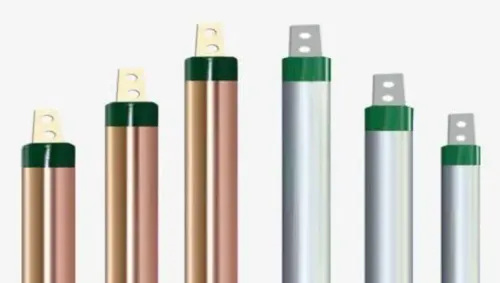
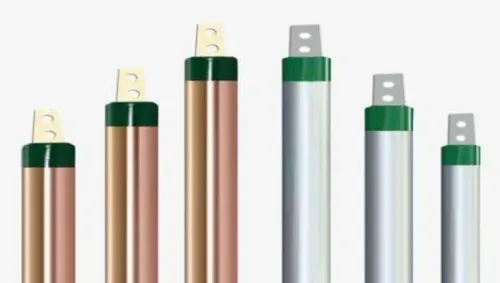
| Solid copper | Highest conductivity; softer and easier to deform during driving | Good corrosion performance in many soils; highest theft risk; service life depends on soil and joints | Highest purchase and replacement cost |
| Copper-bonded steel | Steel core tolerates driving forces; copper outer layer provides conductive surface | Lower theft risk; bond damage or exposed steel can accelerate corrosion | Lower material cost and usually the best compromise |
| GI | Lower conductivity; steel provides good driving strength | Zinc coating is consumed by corrosion; lowest theft risk; life depends strongly on soil chemistry | Lowest purchase cost, but replacement and excavation can raise lifecycle cost |
A Wenner four-pin soil-resistivity survey is more useful than choosing copper automatically. Equal probe spacing reveals apparent resistivity; repeat readings at increasing spacing help identify soil layering. Moisture changes resistance, while electrode length, diameter, geometry and parallel rods change current distribution. Closely spaced rods do not reduce resistance in direct proportion to their number.
Consider solid copper for acidic or contaminated soil, difficult maintenance access, a long project life or demanding fault-current duty. Choose copper-bonded steel when driving forces, theft risk and purchase cost dominate.
Low electrode resistance alone proves neither acceptable touch or step voltage, conductor thermal withstand nor protective-device clearing performance. Check the complete grounding and protection design.
What should an industrial buyer demand from a Chakan supplier before placing an order?
Reject a quotation that says only “copper earthing rod.” Demand the finished diameter and length, dimensional tolerance, straightness, installation depth, copper purity or material grade, construction type, tip and driving-head design, short-circuit current rating, compatible conductor size, target resistance or impedance, test method and approved connector.
| Option | Construction | What to verify |
|---|---|---|
| Solid copper | Copper throughout | Purity, strength, diameter and driving damage |
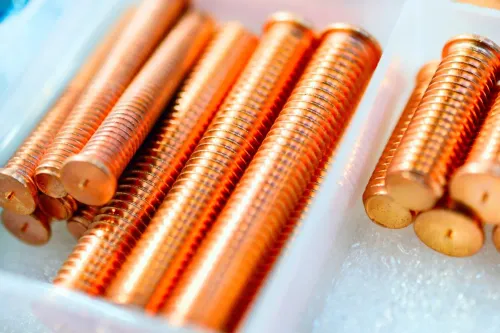
| Copper-plated steel | Steel with a copper coating | Coating thickness, base-steel grade and exposed steel |
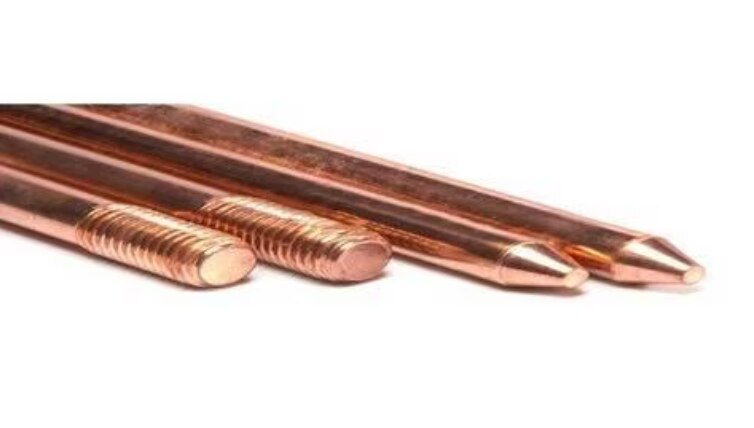
| Copper-bonded steel | Steel core metallurgically bonded to copper | Bond integrity, continuity and uniform copper thickness |
Inspect a cut sample or manufacturer cross-section. Request coating-thickness readings at multiple points, bond-integrity or continuity-test records, and photographs showing no exposed steel at the tip, threads or scratches.
- Material certificate, batch or heat number, dimensional inspection report and test certificate.
- Installation instructions, refusal criteria, connector compatibility, warranty terms, lead time and minimum order quantity.
- Rod location, final depth, conductor size and resistance target in the installation record.
A copper earthing rod manufacturer in Chakan for industrial buyers should supply this evidence before dispatch. ELECTROTECH INDUSTRIES is one local manufacturer a buyer can ask to provide it. A copper earthing rod supplier Chakan is useful for delivery and replacement only when traceability, compatibility evidence and installation support accompany the quotation.
Local proximity does not prove suitability.
Related products
 | Copper Earthing Rod Manufacturer in Pune – Electrotech Industries Electrotech Industries is a trusted manufacturer and supplier of copper earthing rods, designed to... View product → |
 | Earthing Rod Manufacturer in Pune – Electrotech Industries Electrotech Industries is a leading manufacturer and supplier of high-performance earthing rods,... View product → |
How should you design and install the electrode instead of simply driving one rod?
An installation scope must define the electrode arrangement, installation method, refusal criteria, target depth, resistance or impedance, and test method—not merely specify an earthing rod for industrial projects chakan.
Drive the rod only through suitable ground. If rubble or hard strata stops it above design depth, record refusal and switch to a drilled bore-and-backfill solution; do not shorten the design silently. Record final depth, coordinates, inspection-pit position and conductor route.
- One rod: use only when soil modelling and measured resistance support it.
- Multiple rods: calculate spacing, orientation and combined resistance; closely packed rods suffer mutual resistance, so four rods do not deliver one-quarter of a single rod’s resistance.
- Ring electrode: use where a building perimeter is accessible.
- Earth grid: use for large yards, high fault current or step-voltage control.
- Chemical electrode: use only with a specified, approved compound.
- Foundation earthing: use where reinforcement and concrete details permit a documented connection.
In uniform soil, increasing length usually reduces resistance more effectively than increasing diameter. Layered soil can make extra length unpredictable, so require a soil model before ordering.
Provide an inspection pit or accessible test link, correctly rated clamps, protected above-ground connections and routed conductors. Any backfill compound needs documented resistivity, corrosion behaviour and long-term data. Never use salt or charcoal. Where copper meets GI or another buried dissimilar metal, specify a designed bimetallic connector.
Coordinate protective earth, transformer-neutral, lightning and instrumentation grounding; isolated “clean earth” rods can create dangerous potential differences.
How do you prove the completed rod or earth grid actually works?
Acceptance starts with a three-point fall-of-potential test, not a single low resistance reading. Isolate the electrode under test from bonded rods, grids and building steel where possible.
Place the current probe and potential probe at suitable distances for the electrode geometry and site, record that layout, then move the potential probe and repeat readings to confirm a stable resistance curve.
A clamp-on ground tester is valid only when parallel return paths exist. It cannot measure an isolated single electrode because the test current has no return path.
| Measurement | Includes | What it proves |
|---|---|---|
| Electrode resistance | Tested electrode, its conductor and connection | Performance of that electrode and its connection |
| System resistance | Bonded rods, grids, structural steel, cable sheaths and other parallel paths | Performance of the connected grounding network |
Keep a test record containing:
- Soil condition, recent weather and electrode identification
- Instrument make, serial number and calibration status
- Current-probe and potential-probe distances, direction and lead layout
- Every reading, probe position and the final resistance or impedance
- Conductor size, joint condition, connection torque or inspection result
- Design target and the pass/fail comparison
Check continuity through every grounding conductor and verify bonding between equipment, structures and the intended grid. Measure touch and step voltage when fault energy or personnel exposure demands it.
A low-ohmic result is not acceptance if the conductor lacks thermal withstand, a joint is defective, or the protective device cannot clear the fault within the designed time.
Which Chakan site conditions change the final buying decision?
A go decision requires a soil model and measured resistivity before you select rod length or electrode count. Catalogue dimensions do not solve rocky ground, imported fill, rubble or high-resistivity strata; a rod can stop above its designed depth and leave the installation ineffective.
| Site condition | Required response | Buying implication |
|---|---|---|
| Rock, rubble or hard strata | Define refusal criteria; use bore-and-backfill or an earth grid when driving cannot reach the designed depth. | Do not approve a driven rod on catalogue length alone. |
| Imported fill or layered soil | Model each layer and measure resistivity with a Wenner four-pin survey. | Longer rods are not automatically better when they enter a poor layer. |
| Variable moisture or groundwater | Measure in representative conditions and account for seasonal change. | Moisture can reduce resistance, while groundwater chemistry can attack joints and conductors. |
| Acidic soil, chemical plant or effluent area | Complete a corrosion assessment, specify compatible metals and provide inspection access. | Never assume copper remains unaffected; protect connections and verify them. |
| Security-sensitive area | Compare exposed solid copper with buried copper-bonded steel. | Theft risk can outweigh copper’s conductivity advantage. |
| Limited maintenance access or long project life | Price inspection, replacement and downtime across the design life. | Higher initial copper cost can be justified by lifecycle value. |
Buy copper when documented soil, corrosion and fault-duty conditions support its lifecycle value. Choose copper-bonded steel or GI when mechanical handling, security and cost dominate, provided the design meets measured resistance, bonding and safety requirements. The decision belongs to the engineered electrode system, not the word copper on the quotation.
Frequently asked questions
When is a copper earthing rod worth its higher price than GI or copper-bonded steel?
Copper earns its premium when corrosion resistance, long service life, compact electrode size or difficult future excavation outweigh the initial cost. Compare soil chemistry, moisture, stray-current exposure, theft risk and the cost of replacing the electrode before choosing it.
What should an industrial buyer demand from a copper earthing rod supplier in Chakan?
Request the rod diameter and length, copper grade or coating thickness, manufacturing standard, batch traceability, dimensional inspection report, material test certificate and warranty terms. Inspect the rod for consistent plating, straightness, clean threads and undamaged connections.
How should you design and install an earthing electrode instead of driving one rod?
Start with a soil-resistivity survey and the required earth resistance. Select rod length, spacing, conductor size, inspection pits and bonding points from the design. Use multiple spaced rods or a buried earth grid when one electrode cannot achieve the target, and protect joints against corrosion.
How do you prove that a completed rod or earth grid works?
Test the installation using the fall-of-potential method where site conditions permit, or use an appropriate clamp method for a bonded network. Record test layout, electrode condition, weather, instrument serial number, calibration status, measured resistance and acceptance limit.
Which Chakan site conditions can change the final copper rod buying decision?
Check soil resistivity, seasonal groundwater variation, rocky or compacted ground, chemical contamination, buried utilities, available installation depth, lightning protection requirements and theft exposure. These factors can favour GI, copper-bonded steel, deeper electrodes, multiple rods or a complete earth grid.
Keywords